
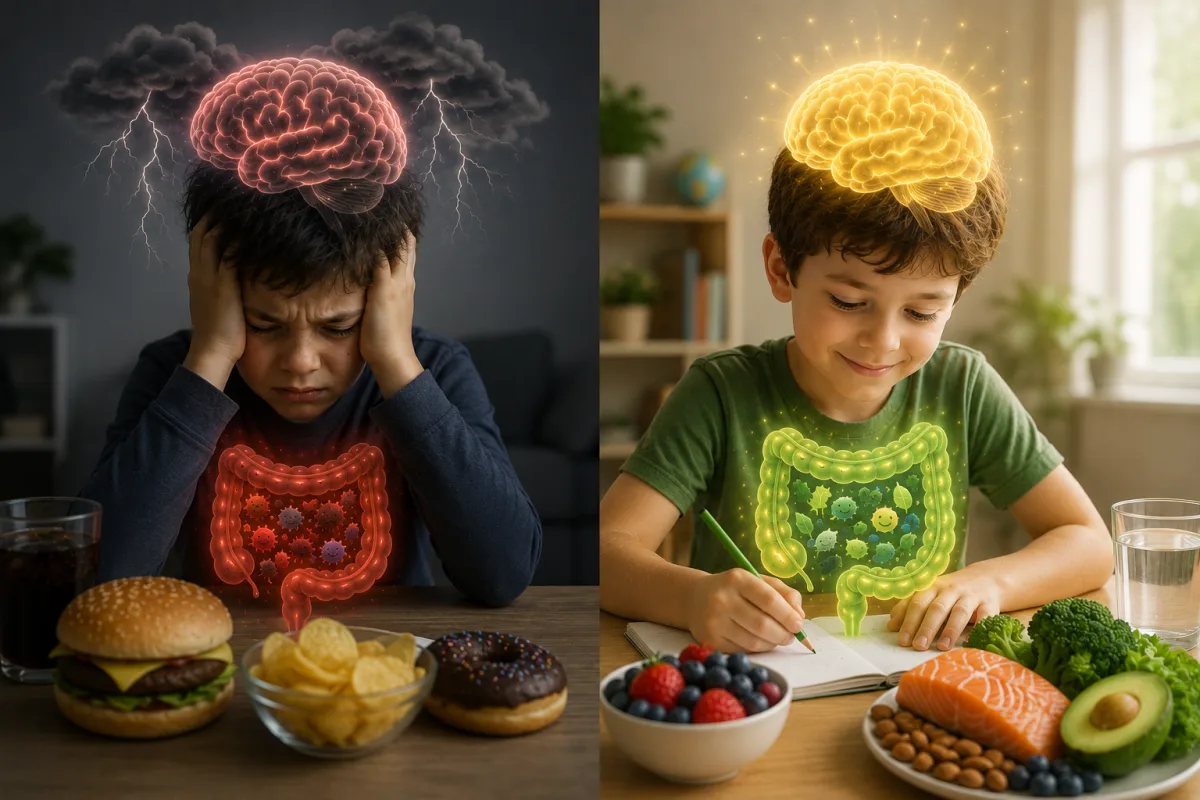
How Your Child's Microbiome Is Affecting Their Focus, Mood, and ADHD

You may notice that every time you go to a restaurant, your child cannot sit still, gets overwhelmed within minutes, starts interrupting constantly, throws a tantrum over something tiny, and suddenly the entire dinner revolves around trying to calm them down.
Or maybe your child seems to be endlessly snacking throughout the day, constantly craving processed foods, struggling to focus, emotionally exploding over small inconveniences, and somehow feeling both exhausted and overstimulated at the same time.
If you are a parent experiencing these situations daily, you are definitely not alone. And while ADHD is becoming a much more common conversation in households and schools, there is another piece of the puzzle that rarely gets discussed enough.
That piece is the direct connection between ultra-processed foods, gut health, the microbiome, and the developing brain. Because the truth is, the brain does not function separately from the rest of the body.
Your child's nervous system is deeply connected to sleep, stress, movement, blood sugar regulation, inflammation, nutrient intake, and especially the health of the gut microbiome, which is the ecosystem of bacteria and microorganisms living inside the digestive tract.
Over the last several years, researchers have become increasingly interested in the gut-brain connection and how the state of the microbiome may influence mood, focus, emotional regulation, behavior patterns, and overall nervous system function.
What we are seeing more and more is that the modern food environment may significantly worsen the intensity of symptoms in children who are already more neurologically sensitive, and that part deserves much more attention than it currently gets.
The Modern Food Environment Is Extremely Hard on Kids
Children today are growing up surrounded by foods that barely resemble real food anymore.
Brightly colored snacks, sugary cereals, processed drinks, fast food, seed oil-heavy packaged products, artificial flavorings, refined carbohydrates, and hyper-palatable combinations of sugar, fat, and salt have become completely normalized in many households.
Even though these foods are specifically engineered to be overstimulating and difficult to stop eating, they are still considered "normal" in many homes.
For many children, especially the ones struggling with focus and impulsivity, these foods can create a cycle that feels almost impossible to regulate.
A breakfast full of sugar and refined carbohydrates may create a quick spike in energy and dopamine, but very often that is followed by a crash in blood sugar, worsening focus, irritability, mood swings, emotional dysregulation, stronger cravings, and another search for stimulation through food shortly afterward.
And when that cycle repeats day after day, week after week, the nervous system rarely gets a chance to stabilize.
At the same time, ultra-processed foods tend to be significantly lower in the nutrients the brain and body actually need to function properly.
Protein, fiber, minerals, omega-3 fats, and nutrient-dense whole foods are often replaced by highly processed calories that may fill the stomach temporarily while still leaving the body undernourished.
And when you combine nutrient deficiencies, blood sugar instability, chronic overstimulation, poor sleep, high screen time, and constant processed food intake together, you create an environment that may make emotional regulation and focus dramatically harder for some children.
The Gut and the Brain Are Constantly Communicating
One of the most fascinating things researchers are now exploring is how closely connected the gut and the brain actually are.
The digestive system communicates continuously with the nervous system through what is often referred to as the gut-brain axis, which means the condition of the microbiome may influence how your child feels emotionally and mentally throughout the day.
The microbiome itself is constantly changing based on repeated daily habits and exposures.
Diet plays a massive role in shaping it, which means that a child eating mostly ultra-processed foods every single day is building a very different internal environment than a child regularly eating whole foods, fiber-rich meals, quality proteins, fruits, vegetables, fermented foods, and healthy fats.
This matters because certain gut bacteria help produce compounds involved in inflammation regulation, nervous system signaling, digestion, and neurotransmitter-related processes.
When the microbiome becomes less diverse and more disrupted over time, especially in combination with chronic stress and poor nutrition, many researchers believe it may contribute to worsening inflammation and dysregulation throughout the body.
Why So Many Children With ADHD Struggle Around Food
Many children with ADHD also struggle with eating patterns that go far beyond physical hunger.
Parents often notice constant snacking, intense cravings for processed foods, eating out of boredom, or emotional eating that usually shows up right after a big emotional moment.
The answer is often easier than most people think.
Highly processed foods are designed to be rewarding to the brain.
They create quick dopamine responses, instant stimulation, and temporary comfort, which can feel especially powerful for children already struggling with impulsivity or emotional regulation.
The problem is that those foods often provide very short-term relief while creating even more instability afterward, which turns into a loop where the child constantly searches for the next snack, the next sugar hit, or the next source of stimulation to feel better again.
Over time, this can affect not only physical health, but also self-esteem, emotional wellbeing, energy levels, confidence around food, and family dynamics at home.
Children Need Supportive Environments, Not More Shame
One of the biggest mistakes parents make is assuming that children struggling with focus, impulsivity, emotional regulation, or eating behaviors simply lack discipline.
In reality, many of these children are trying to function inside environments that overstimulate their nervous systems all day long while under-supporting the body nutritionally at the same time.
Children do not need more shame around food. They need structure, education, consistency, balanced meals, and healthy routines that make healthy choices easier instead of constantly relying on willpower alone.
Because the environment almost always wins over willpower in the long run. We also explored this in our article on why GLP-1s are not the answer for childhood obesity.
A child surrounded by ultra-processed snacks, constant sugar exposure, irregular routines, and emotional stress is not weak for struggling. Their body and brain are responding exactly how human biology is designed to respond.
That is why improving your child's nutrition and gut health is not about creating obsession around "perfect eating." It is about building a stronger foundation for the nervous system so the brain and body are better supported overall.
The Goal Is to Support the Whole Child
At Step Together, we believe children deserve a much bigger conversation than simply labeling symptoms without looking at the full picture.
The goal is not perfection, fear around food, or unrealistic restrictions. The goal is helping families understand how deeply connected the body, brain, emotions, environment, habits, and nutrition truly are.
Because sometimes the question is not simply, "What is wrong with this child?" Usually, the better question is, "What is this child's body trying to communicate?"
And the more we understand the connection between ultra-processed foods, gut health, inflammation, the microbiome, and the nervous system, the more effectively we can support children long term in a way that helps them feel healthier, calmer, and more regulated.
And most importantly, more connected to their own bodies.
Ready to create lasting change for your family?
Apply Here